Wednesday, December 24, 2008

Ridiculous Manic Hysteria of the Week

Scientists warn Christmas lights harm the planet

Article from: The Courier-Mail

By Graham Readfearn

December 24, 2008 08:06am

SCIENTISTS have warned that Christmas lights are bad for the planet due to huge electricity waste and urged people to get energy efficient festive bulbs.

CSIRO researchers said householders should know that each bulb turned on in the name of Christmas will increase emissions of greenhouse gases.

Dr Glenn Platt, who leads research on energy demand, said Australia got 80 per cent of its electricity by burning coal which pumps harmful emissions into the atmosphere.

He said: "Energy efficient bulbs, such as LEDs, and putting your Christmas lights on a timer are two very easy ways to minimise the amount of electricity you use to power your lights."

He said the nation's electricity came from "centralised carbon intensive, coal-based power stations" which were responsible for emitting over one third of Australia's greenhouse gas emissions.

Dr Platt added: "For a zero-emission Christmas light show, you may consider using solar powered lights or sourcing your electricity from verified green power suppliers."

Friday, December 19, 2008

CNN Meteorologist: Manmade Global Warming Theory 'Arrogant'
Network's second meteorologist to challenge notion man can alter climate.

By Jeff Poor
Business & Media Institute
12/18/2008 11:02:44 PM


Unprecedented snow in Las Vegas has some scratching their heads – how can there be global warming with this unusual cold and snowy weather?

CNN Meteorologist Chad Myers had never bought into the notion that man can alter the climate and the Vegas snowstorm didn’t impact his opinion. Myers, an American Meteorological Society certified meteorologist, explained on CNN’s Dec. 18 “Lou Dobbs Tonight” that the whole idea is arrogant and mankind was in danger of dying from other natural events more so than global warming.

“You know, to think that we could affect weather all that much is pretty arrogant,” Myers said. “Mother Nature is so big, the world is so big, the oceans are so big – I think we’re going to die from a lack of fresh water or we’re going to die from ocean acidification before we die from global warming, for sure.”

Myers is the second CNN meteorologist to challenge the global warming conventions common in the media. He also said trying to determine patterns occurring in the climate would be difficult based on such a short span.

“But this is like, you know you said – in your career – my career has been 22 years long,” Myers said. “That’s a good career in TV, but talking about climate – it’s like having a car for three days and saying, ‘This is a great car.’ Well, yeah – it was for three days, but maybe in days five, six and seven it won’t be so good. And that’s what we’re doing here.”

“We have 100 years worth of data, not millions of years that the world’s been around,” Myers continued.

Dr. Jay Lehr, an expert on environmental policy, told “Lou Dobbs Tonight” viewers you can detect subtle patterns over recorded history, but that dates back to the 13th Century.

“If we go back really, in recorded human history, in the 13th Century, we were probably 7 degrees Fahrenheit warmer than we are now and it was a very prosperous time for mankind,” Lehr said. “If go back to the Revolutionary War 300 years ago, it was very, very cold. We’ve been warming out of that cold spell from the Revolutionary War period and now we’re back into a cooling cycle.”

Lehr suggested the earth is presently entering a cooling cycle – a result of nature, not man.

“The last 10 years have been quite cool,” Lehr continued. “And right now, I think we’re going into cooling rather than warming and that should be a much greater concern for humankind. But, all we can do is adapt. It is the sun that does it, not man.”

Lehr is a senior fellow and science director of The Heartland Institute, an organization that will be holding the 2009 International Conference on Climate Change in New York March 8-10.

Another CNN meteorologist attacked the concept that man is somehow responsible for changes in climate last year. Rob Marciano charged Al Gore’s 2006 movie, “An Inconvenient Truth,” had some inaccuracies.

“There are definitely some inaccuracies,” Marciano said during the Oct. 4, 2007 broadcast of CNN’s “American Morning.” “The biggest thing I have a problem with is this implication that Katrina was caused by global warming.”

Marciano also said that, “global warming does not conclusively cause stronger hurricanes like we’ve seen,” pointing out that “by the end of this century we might get about a 5 percent increase.”

His comments drew a strong response and he recanted the next day saying “the globe is getting warmer and humans are the likely the main cause of it.”

Monday, November 10, 2008

Michael Crichton on Consensus and Misappropriation of Science

A speech Dr. Crichton delivered at the CIT in 2003

California Institute of Technology
Pasadena, CA
January 17, 2003

An historical approach detailing how over the last thirty years scientists have begun to intermingle scientific and political claims.


My topic today sounds humorous but unfortunately I am serious. I am going to argue that extraterrestrials lie behind global warming. Or to speak more precisely, I will argue that a belief in extraterrestrials has paved the way, in a progression of steps, to a belief in global warming. Charting this progression of belief will be my task today.

Let me say at once that I have no desire to discourage anyone from believing in either extraterrestrials or global warming. That would be quite impossible to do. Rather, I want to discuss the history of several widely-publicized beliefs and to point to what I consider an emerging crisis in the whole enterprise of science-namely the increasingly uneasy relationship between hard science and public policy.

I have a special interest in this because of my own upbringing. I was born in the midst of World War II, and passed my formative years at the height of the Cold War. In school drills, I dutifully crawled under my desk in preparation for a nuclear attack.

It was a time of widespread fear and uncertainty, but even as a child I believed that science represented the best and greatest hope for mankind. Even to a child, the contrast was clear between the world of politics-a world of hate and danger, of irrational beliefs and fears, of mass manipulation and disgraceful blots on human history. In contrast, science held different values-international in scope, forging friendships and working relationships across national boundaries and political systems, encouraging a dispassionate habit of thought, and ultimately leading to fresh knowledge and technology that would benefit all mankind. The world might not be a very good place, but science would make it better. And it did. In my lifetime, science has largely fulfilled its promise. Science has been the great intellectual adventure of our age, and a great hope for our troubled and restless world.

But I did not expect science merely to extend lifespan, feed the hungry, cure disease, and shrink the world with jets and cell phones. I also expected science to banish the evils of human thought---prejudice and superstition, irrational beliefs and false fears. I expected science to be, in Carl Sagan's memorable phrase, "a candle in a demon haunted world." And here, I am not so pleased with the impact of science. Rather than serving as a cleansing force, science has in some instances been seduced by the more ancient lures of politics and publicity. Some of the demons that haunt our world in recent years are invented by scientists. The world has not benefited from permitting these demons to escape free.

But let's look at how it came to pass.

Cast your minds back to 1960. John F. Kennedy is president, commercial jet airplanes are just appearing, the biggest university mainframes have 12K of memory. And in Green Bank, West Virginia at the new National Radio Astronomy Observatory, a young astrophysicist named Frank Drake runs a two week project called Ozma, to search for extraterrestrial signals. A signal is received, to great excitement. It turns out to be false, but the excitement remains. In 1960, Drake organizes the first SETI conference, and came up with the now-famous Drake equation:

N=N*fp ne fl fi fc fL

Where N is the number of stars in the Milky Way galaxy; fp is the fraction with planets; ne is the number of planets per star capable of supporting life; fl is the fraction of planets where life evolves; fi is the fraction where intelligent life evolves; and fc is the fraction that communicates; and fL is the fraction of the planet's life during which the communicating civilizations live.

This serious-looking equation gave SETI an serious footing as a legitimate intellectual inquiry. The problem, of course, is that none of the terms can be known, and most cannot even be estimated. The only way to work the equation is to fill in with guesses. And guesses-just so we're clear-are merely expressions of prejudice. Nor can there be "informed guesses." If you need to state how many planets with life choose to communicate, there is simply no way to make an informed guess. It's simply prejudice.

As a result, the Drake equation can have any value from "billions and billions" to zero. An expression that can mean anything means nothing. Speaking precisely, the Drake equation is literally meaningless, and has nothing to do with science. I take the hard view that science involves the creation of testable hypotheses. The Drake equation cannot be tested and therefore SETI is not science. SETI is unquestionably a religion. Faith is defined as the firm belief in something for which there is no proof. The belief that the Koran is the word of God is a matter of faith. The belief that God created the universe in seven days is a matter of faith. The belief that there are other life forms in the universe is a matter of faith. There is not a single shred of evidence for any other life forms, and in forty years of searching, none has been discovered. There is absolutely no evidentiary reason to maintain this belief. SETI is a religion.

One way to chart the cooling of enthusiasm is to review popular works on the subject. In 1964, at the height of SETI enthusiasm, Walter Sullivan of the NY Times wrote an exciting book about life in the universe entitled WE ARE NOT ALONE. By 1995, when Paul Davis wrote a book on the same subject, he titled it ARE WE ALONE? ( Since 1981, there have in fact been four books titled ARE WE ALONE.) More recently we have seen the rise of the so-called "Rare Earth" theory which suggests that we may, in fact, be all alone. Again, there is no evidence either way.

Back in the sixties, SETI had its critics, although not among astrophysicists and astronomers. The biologists and paleontologists were harshest. George Gaylord Simpson of Harvard sneered that SETI was a "study without a subject," and it remains so to the present day.

But scientists in general have been indulgent toward SETI, viewing it either with bemused tolerance, or with indifference. After all, what's the big deal? It's kind of fun. If people want to look, let them. Only a curmudgeon would speak harshly of SETI. It wasn't worth the bother.

And of course it is true that untestable theories may have heuristic value. Of course extraterrestrials are a good way to teach science to kids. But that does not relieve us of the obligation to see the Drake equation clearly for what it is-pure speculation in quasi-scientific trappings.

The fact that the Drake equation was not greeted with screams of outrage-similar to the screams of outrage that greet each Creationist new claim, for example-meant that now there was a crack in the door, a loosening of the definition of what constituted legitimate scientific procedure. And soon enough, pernicious garbage began to squeeze through the cracks.

Now let's jump ahead a decade to the 1970s, and Nuclear Winter.

In 1975, the National Academy of Sciences reported on "Long-Term Worldwide Effects of Multiple Nuclear Weapons Detonations" but the report estimated the effect of dust from nuclear blasts to be relatively minor. In 1979, the Office of Technology Assessment issued a report on "The Effects of Nuclear War" and stated that nuclear war could perhaps produce irreversible adverse consequences on the environment. However, because the scientific processes involved were poorly understood, the report stated it was not possible to estimate the probable magnitude of such damage.

Three years later, in 1982, the Swedish Academy of Sciences commissioned a report entitled "The Atmosphere after a Nuclear War: Twilight at Noon," which attempted to quantify the effect of smoke from burning forests and cities. The authors speculated that there would be so much smoke that a large cloud over the northern hemisphere would reduce incoming sunlight below the level required for photosynthesis, and that this would last for weeks or even longer.

The following year, five scientists including Richard Turco and Carl Sagan published a paper in Science called "Nuclear Winter: Global Consequences of Multiple Nuclear Explosions." This was the so-called TTAPS report, which attempted to quantify more rigorously the atmospheric effects, with the added credibility to be gained from an actual computer model of climate.

At the heart of the TTAPS undertaking was another equation, never specifically expressed, but one that could be paraphrased as follows:

Ds = Wn Ws Wh Tf Tb Pt Pr Pe… etc

(The amount of tropospheric dust=# warheads x size warheads x warhead detonation height x flammability of targets x Target burn duration x Particles entering the Troposphere x Particle reflectivity x Particle endurance…and so on.)

The similarity to the Drake equation is striking. As with the Drake equation, none of the variables can be determined. None at all. The TTAPS study addressed this problem in part by mapping out different wartime scenarios and assigning numbers to some of the variables, but even so, the remaining variables were-and are-simply unknowable. Nobody knows how much smoke will be generated when cities burn, creating particles of what kind, and for how long. No one knows the effect of local weather conditions on the amount of particles that will be injected into the troposphere. No one knows how long the particles will remain in the troposphere. And so on.

And remember, this is only four years after the OTA study concluded that the underlying scientific processes were so poorly known that no estimates could be reliably made. Nevertheless, the TTAPS study not only made those estimates, but concluded they were catastrophic.

According to Sagan and his co-workers, even a limited 5,000 megaton nuclear exchange would cause a global temperature drop of more than 35 degrees Centigrade, and this change would last for three months. The greatest volcanic eruptions that we know of changed world temperatures somewhere between .5 and 2 degrees Centigrade. Ice ages changed global temperatures by 10 degrees. Here we have an estimated change three times greater than any ice age. One might expect it to be the subject of some dispute.

But Sagan and his co-workers were prepared, for nuclear winter was from the outset the subject of a well-orchestrated media campaign. The first announcement of nuclear winter appeared in an article by Sagan in the Sunday supplement, Parade. The very next day, a highly-publicized, high-profile conference on the long-term consequences of nuclear war was held in Washington, chaired by Carl Sagan and Paul Ehrlich, the most famous and media-savvy scientists of their generation. Sagan appeared on the Johnny Carson show 40 times. Ehrlich was on 25 times. Following the conference, there were press conferences, meetings with congressmen, and so on. The formal papers in Science came months later.

This is not the way science is done, it is the way products are sold.

The real nature of the conference is indicated by these artists' renderings of the effect of nuclear winter.

I cannot help but quote the caption for figure 5: "Shown here is a tranquil scene in the north woods. A beaver has just completed its dam, two black bears forage for food, a swallow-tailed butterfly flutters in the foreground, a loon swims quietly by, and a kingfisher searches for a tasty fish." Hard science if ever there was.

At the conference in Washington, during the question period, Ehrlich was reminded that after Hiroshima and Nagasaki, scientists were quoted as saying nothing would grow there for 75 years, but in fact melons were growing the next year. So, he was asked, how accurate were these findings now?

Ehrlich answered by saying "I think they are extremely robust. Scientists may have made statements like that, although I cannot imagine what their basis would have been, even with the state of science at that time, but scientists are always making absurd statements, individually, in various places. What we are doing here, however, is presenting a consensus of a very large group of scientists…"

I want to pause here and talk about this notion of consensus, and the rise of what has been called consensus science. I regard consensus science as an extremely pernicious development that ought to be stopped cold in its tracks. Historically, the claim of consensus has been the first refuge of scoundrels; it is a way to avoid debate by claiming that the matter is already settled. Whenever you hear the consensus of scientists agrees on something or other, reach for your wallet, because you're being had.

Let's be clear: the work of science has nothing whatever to do with consensus. Consensus is the business of politics. Science, on the contrary, requires only one investigator who happens to be right, which means that he or she has results that are verifiable by reference to the real world. In science consensus is irrelevant. What is relevant is reproducible results. The greatest scientists in history are great precisely because they broke with the consensus.

There is no such thing as consensus science. If it's consensus, it isn't science. If it's science, it isn't consensus. Period.

In addition, let me remind you that the track record of the consensus is nothing to be proud of. Let's review a few cases.

In past centuries, the greatest killer of women was fever following childbirth . One woman in six died of this fever. In 1795, Alexander Gordon of Aberdeen suggested that the fevers were infectious processes, and he was able to cure them. The consensus said no. In 1843, Oliver Wendell Holmes claimed puerperal fever was contagious, and presented compelling evidence. The consensus said no. In 1849, Semmelweiss demonstrated that sanitary techniques virtually eliminated puerperal fever in hospitals under his management. The consensus said he was a Jew, ignored him, and dismissed him from his post. There was in fact no agreement on puerperal fever until the start of the twentieth century. Thus the consensus took one hundred and twenty five years to arrive at the right conclusion despite the efforts of the prominent "skeptics" around the world, skeptics who were demeaned and ignored. And despite the constant ongoing deaths of women.

There is no shortage of other examples. In the 1920s in America, tens of thousands of people, mostly poor, were dying of a disease called pellagra. The consensus of scientists said it was infectious, and what was necessary was to find the "pellagra germ." The US government asked a brilliant young investigator, Dr. Joseph Goldberger, to find the cause. Goldberger concluded that diet was the crucial factor. The consensus remained wedded to the germ theory. Goldberger demonstrated that he could induce the disease through diet. He demonstrated that the disease was not infectious by injecting the blood of a pellagra patient into himself, and his assistant. They and other volunteers swabbed their noses with swabs from pellagra patients, and swallowed capsules containing scabs from pellagra rashes in what were called "Goldberger's filth parties." Nobody contracted pellagra. The consensus continued to disagree with him. There was, in addition, a social factor-southern States disliked the idea of poor diet as the cause, because it meant that social reform was required. They continued to deny it until the 1920s. Result-despite a twentieth century epidemic, the consensus took years to see the light.

Probably every schoolchild notices that South America and Africa seem to fit together rather snugly, and Alfred Wegener proposed, in 1912, that the continents had in fact drifted apart. The consensus sneered at continental drift for fifty years. The theory was most vigorously denied by the great names of geology-until 1961, when it began to seem as if the sea floors were spreading. The result: it took the consensus fifty years to acknowledge what any schoolchild sees.

And shall we go on? The examples can be multiplied endlessly. Jenner and smallpox, Pasteur and germ theory. Saccharine, margarine, repressed memory, fiber and colon cancer, hormone replacement therapy…the list of consensus errors goes on and on.

Finally, I would remind you to notice where the claim of consensus is invoked. Consensus is invoked only in situations where the science is not solid enough. Nobody says the consensus of scientists agrees that E=mc2. Nobody says the consensus is that the sun is 93 million miles away. It would never occur to anyone to speak that way.

But back to our main subject.

What I have been suggesting to you is that nuclear winter was a meaningless formula, tricked out with bad science, for policy ends. It was political from the beginning, promoted in a well-orchestrated media campaign that had to be planned weeks or months in advance.

Further evidence of the political nature of the whole project can be found in the response to criticism. Although Richard Feynman was characteristically blunt, saying, "I really don't think these guys know what they're talking about," other prominent scientists were noticeably reticent. Freeman Dyson was quoted as saying "It's an absolutely atrocious piece of science but…who wants to be accused of being in favor of nuclear war?" And Victor Weisskopf said, "The science is terrible but---perhaps the psychology is good." The nuclear winter team followed up the publication of such comments with letters to the editors denying that these statements were ever made, though the scientists since then have subsequently confirmed their views.

At the time, there was a concerted desire on the part of lots of people to avoid nuclear war. If nuclear winter looked awful, why investigate too closely? Who wanted to disagree? Only people like Edward Teller, the "father of the H bomb."

Teller said, "While it is generally recognized that details are still uncertain and deserve much more study, Dr. Sagan nevertheless has taken the position that the whole scenario is so robust that there can be little doubt about its main conclusions." Yet for most people, the fact that nuclear winter was a scenario riddled with uncertainties did not seem to be relevant.

I say it is hugely relevant. Once you abandon strict adherence to what science tells us, once you start arranging the truth in a press conference, then anything is possible. In one context, maybe you will get some mobilization against nuclear war. But in another context, you get Lysenkoism. In another, you get Nazi euthanasia. The danger is always there, if you subvert science to political ends.

That is why it is so important for the future of science that the line between what science can say with certainty, and what it cannot, be drawn clearly-and defended.

What happened to Nuclear Winter? As the media glare faded, its robust scenario appeared less persuasive; John Maddox, editor of Nature, repeatedly criticized its claims; within a year, Stephen Schneider, one of the leading figures in the climate model, began to speak of "nuclear autumn." It just didn't have the same ring.

A final media embarrassment came in 1991, when Carl Sagan predicted on Nightline that Kuwaiti oil fires would produce a nuclear winter effect, causing a "year without a summer," and endangering crops around the world. Sagan stressed this outcome was so likely that "it should affect the war plans." None of it happened.

What, then, can we say were the lessons of Nuclear Winter? I believe the lesson was that with a catchy name, a strong policy position and an aggressive media campaign, nobody will dare to criticize the science, and in short order, a terminally weak thesis will be established as fact. After that, any criticism becomes beside the point. The war is already over without a shot being fired. That was the lesson, and we had a textbook application soon afterward, with second hand smoke.

In 1993, the EPA announced that second-hand smoke was "responsible for approximately 3,000 lung cancer deaths each year in nonsmoking adults," and that it " impairs the respiratory health of hundreds of thousands of people." In a 1994 pamphlet the EPA said that the eleven studies it based its decision on were not by themselves conclusive, and that they collectively assigned second-hand smoke a risk factor of 1.19. (For reference, a risk factor below 3.0 is too small for action by the EPA. or for publication in the New England Journal of Medicine, for example.) Furthermore, since there was no statistical association at the 95% confidence limits, the EPA lowered the limit to 90%. They then classified second hand smoke as a Group A Carcinogen.

This was openly fraudulent science, but it formed the basis for bans on smoking in restaurants, offices, and airports. California banned public smoking in 1995. Soon, no claim was too extreme. By 1998, the Christian Science Monitor was saying that "Second-hand smoke is the nation's third-leading preventable cause of death." The American Cancer Society announced that 53,000 people died each year of second-hand smoke. The evidence for this claim is nonexistent.

In 1998, a Federal judge held that the EPA had acted improperly, had "committed to a conclusion before research had begun", and had "disregarded information and made findings on selective information." The reaction of Carol Browner, head of the EPA was: "We stand by our science….there's wide agreement. The American people certainly recognize that exposure to second hand smoke brings…a whole host of health problems." Again, note how the claim of consensus trumps science. In this case, it isn't even a consensus of scientists that Browner evokes! It's the consensus of the American people.

Meanwhile, ever-larger studies failed to confirm any association. A large, seven-country WHO study in 1998 found no association. Nor have well-controlled subsequent studies, to my knowledge. Yet we now read, for example, that second hand smoke is a cause of breast cancer. At this point you can say pretty much anything you want about second-hand smoke.

As with nuclear winter, bad science is used to promote what most people would consider good policy. I certainly think it is. I don't want people smoking around me. So who will speak out against banning second-hand smoke? Nobody, and if you do, you'll be branded a shill of RJ Reynolds. A big tobacco flunky. But the truth is that we now have a social policy supported by the grossest of superstitions. And we've given the EPA a bad lesson in how to behave in the future. We've told them that cheating is the way to succeed.

As the twentieth century drew to a close, the connection between hard scientific fact and public policy became increasingly elastic. In part this was possible because of the complacency of the scientific profession; in part because of the lack of good science education among the public; in part, because of the rise of specialized advocacy groups which have been enormously effective in getting publicity and shaping policy; and in great part because of the decline of the media as an independent assessor of fact. The deterioration of the American media is dire loss for our country. When distinguished institutions like the New York Times can no longer differentiate between factual content and editorial opinion, but rather mix both freely on their front page, then who will hold anyone to a higher standard?

And so, in this elastic anything-goes world where science-or non-science-is the hand maiden of questionable public policy, we arrive at last at global warming. It is not my purpose here to rehash the details of this most magnificent of the demons haunting the world. I would just remind you of the now-familiar pattern by which these things are established. Evidentiary uncertainties are glossed over in the unseemly rush for an overarching policy, and for grants to support the policy by delivering findings that are desired by the patron. Next, the isolation of those scientists who won't get with the program, and the characterization of those scientists as outsiders and "skeptics" in quotation marks-suspect individuals with suspect motives, industry flunkies, reactionaries, or simply anti-environmental nutcases. In short order, debate ends, even though prominent scientists are uncomfortable about how things are being done.

When did "skeptic" become a dirty word in science? When did a skeptic require quotation marks around it?

To an outsider, the most significant innovation in the global warming controversy is the overt reliance that is being placed on models. Back in the days of nuclear winter, computer models were invoked to add weight to a conclusion: "These results are derived with the help of a computer model." But now large-scale computer models are seen as generating data in themselves. No longer are models judged by how well they reproduce data from the real world-increasingly, models provide the data. As if they were themselves a reality. And indeed they are, when we are projecting forward. There can be no observational data about the year 2100. There are only model runs.

This fascination with computer models is something I understand very well. Richard Feynmann called it a disease. I fear he is right. Because only if you spend a lot of time looking at a computer screen can you arrive at the complex point where the global warming debate now stands.

Nobody believes a weather prediction twelve hours ahead. Now we're asked to believe a prediction that goes out 100 years into the future? And make financial investments based on that prediction? Has everybody lost their minds?

Stepping back, I have to say the arrogance of the modelmakers is breathtaking. There have been, in every century, scientists who say they know it all. Since climate may be a chaotic system-no one is sure-these predictions are inherently doubtful, to be polite. But more to the point, even if the models get the science spot-on, they can never get the sociology. To predict anything about the world a hundred years from now is simply absurd.

Look: If I was selling stock in a company that I told you would be profitable in 2100, would you buy it? Or would you think the idea was so crazy that it must be a scam?

Let's think back to people in 1900 in, say, New York. If they worried about people in 2000, what would they worry about? Probably: Where would people get enough horses? And what would they do about all the horseshit? Horse pollution was bad in 1900, think how much worse it would be a century later, with so many more people riding horses?

But of course, within a few years, nobody rode horses except for sport. And in 2000, France was getting 80% its power from an energy source that was unknown in 1900. Germany, Switzerland, Belgium and Japan were getting more than 30% from this source, unknown in 1900. Remember, people in 1900 didn't know what an atom was. They didn't know its structure. They also didn't know what a radio was, or an airport, or a movie, or a television, or a computer, or a cell phone, or a jet, an antibiotic, a rocket, a satellite, an MRI, ICU, IUD, IBM, IRA, ERA, EEG, EPA, IRS, DOD, PCP, HTML, internet. interferon, instant replay, remote sensing, remote control, speed dialing, gene therapy, gene splicing, genes, spot welding, heat-seeking, bipolar, prozac, leotards, lap dancing, email, tape recorder, CDs, airbags, plastic explosive, plastic, robots, cars, liposuction, transduction, superconduction, dish antennas, step aerobics, smoothies, twelve-step, ultrasound, nylon, rayon, teflon, fiber optics, carpal tunnel, laser surgery, laparoscopy, corneal transplant, kidney transplant, AIDS… None of this would have meant anything to a person in the year 1900. They wouldn't know what you are talking about.

Now. You tell me you can predict the world of 2100. Tell me it's even worth thinking about. Our models just carry the present into the future. They're bound to be wrong. Everybody who gives a moment's thought knows it.

I remind you that in the lifetime of most scientists now living, we have already had an example of dire predictions set aside by new technology. I refer to the green revolution. In 1960, Paul Ehrlich said, "The battle to feed humanity is over. In the 1970s the world will undergo famines-hundreds of millions of people are going to starve to death." Ten years later, he predicted four billion people would die during the 1980s, including 65 million Americans. The mass starvation that was predicted never occurred, and it now seems it isn't ever going to happen. Nor is the population explosion going to reach the numbers predicted even ten years ago. In 1990, climate modelers anticipated a world population of 11 billion by 2100. Today, some people think the correct number will be 7 billion and falling. But nobody knows for sure.

But it is impossible to ignore how closely the history of global warming fits on the previous template for nuclear winter. Just as the earliest studies of nuclear winter stated that the uncertainties were so great that probabilities could never be known, so, too the first pronouncements on global warming argued strong limits on what could be determined with certainty about climate change. The 1995 IPCC draft report said, "Any claims of positive detection of significant climate change are likely to remain controversial until uncertainties in the total natural variability of the climate system are reduced." It also said, "No study to date has positively attributed all or part of observed climate changes to anthropogenic causes." Those statements were removed, and in their place appeared: "The balance of evidence suggests a discernable human influence on climate."

What is clear, however, is that on this issue, science and policy have become inextricably mixed to the point where it will be difficult, if not impossible, to separate them out. It is possible for an outside observer to ask serious questions about the conduct of investigations into global warming, such as whether we are taking appropriate steps to improve the quality of our observational data records, whether we are systematically obtaining the information that will clarify existing uncertainties, whether we have any organized disinterested mechanism to direct research in this contentious area.

The answer to all these questions is no. We don't.

In trying to think about how these questions can be resolved, it occurs to me that in the progression from SETI to nuclear winter to second hand smoke to global warming, we have one clear message, and that is that we can expect more and more problems of public policy dealing with technical issues in the future-problems of ever greater seriousness, where people care passionately on all sides.

And at the moment we have no mechanism to get good answers. So I will propose one.

Just as we have established a tradition of double-blinded research to determine drug efficacy, we must institute double-blinded research in other policy areas as well. Certainly the increased use of computer models, such as GCMs, cries out for the separation of those who make the models from those who verify them. The fact is that the present structure of science is entrepreneurial, with individual investigative teams vying for funding from organizations which all too often have a clear stake in the outcome of the research - or appear to, which may be just as bad. This is not healthy for science.

Sooner or later, we must form an independent research institute in this country. It must be funded by industry, by government, and by private philanthropy, both individuals and trusts. The money must be pooled, so that investigators do not know who is paying them. The institute must fund more than one team to do research in a particular area, and the verification of results will be a foregone requirement: teams will know their results will be checked by other groups. In many cases, those who decide how to gather the data will not gather it, and those who gather the data will not analyze it. If we were to address the land temperature records with such rigor, we would be well on our way to an understanding of exactly how much faith we can place in global warming, and therefore what seriousness we must address this.

I believe that as we come to the end of this litany, some of you may be saying, well what is the big deal, really. So we made a few mistakes. So a few scientists have overstated their cases and have egg on their faces. So what.

Well, I'll tell you.

In recent years, much has been said about the post modernist claims about science to the effect that science is just another form of raw power, tricked out in special claims for truth-seeking and objectivity that really have no basis in fact. Science, we are told, is no better than any other undertaking. These ideas anger many scientists, and they anger me. But recent events have made me wonder if they are correct. We can take as an example the scientific reception accorded a Danish statistician, Bjorn Lomborg, who wrote a book called The Skeptical Environmentalist.

The scientific community responded in a way that can only be described as disgraceful. In professional literature, it was complained he had no standing because he was not an earth scientist. His publisher, Cambridge University Press, was attacked with cries that the editor should be fired, and that all right-thinking scientists should shun the press. The past president of the AAAS wondered aloud how Cambridge could have ever "published a book that so clearly could never have passed peer review." )But of course the manuscript did pass peer review by three earth scientists on both sides of the Atlantic, and all recommended publication.) But what are scientists doing attacking a press? Is this the new McCarthyism-coming from scientists?

Worst of all was the behavior of the Scientific American, which seemed intent on proving the post-modernist point that it was all about power, not facts. The Scientific American attacked Lomborg for eleven pages, yet only came up with nine factual errors despite their assertion that the book was "rife with careless mistakes." It was a poor display featuring vicious ad hominem attacks, including comparing him to a Holocaust denier. The issue was captioned: "Science defends itself against the Skeptical Environmentalist." Really. Science has to defend itself? Is this what we have come to?

When Lomborg asked for space to rebut his critics, he was given only a page and a half. When he said it wasn't enough, he put the critics' essays on his web page and answered them in detail. Scientific American threatened copyright infringement and made him take the pages down.

Further attacks since have made it clear what is going on. Lomborg is charged with heresy. That's why none of his critics needs to substantiate their attacks in any detail. That's why the facts don't matter. That's why they can attack him in the most vicious personal terms. He's a heretic.

Of course, any scientist can be charged as Galileo was charged. I just never thought I'd see the Scientific American in the role of mother church.

Is this what science has become? I hope not. But it is what it will become, unless there is a concerted effort by leading scientists to aggressively separate science from policy. The late Philip Handler, former president of the National Academy of Sciences, said that "Scientists best serve public policy by living within the ethics of science, not those of politics. If the scientific community will not unfrock the charlatans, the public will not discern the difference-science and the nation will suffer." Personally, I don't worry about the nation. But I do worry about science.

Thank you very much.

Wednesday, November 5, 2008

Deny AGW and kill your career

Express Yourself

BBC SHUNNED ME FOR DENYING CLIMATE CHANGE

Story Image


SHUNNED: Naturalist David Bellamy

Wednesday November 5,2008

FOR YEARS David Bellamy was one of the best known faces on TV.

A respected botanist and the author of 35 books, he had presented around 400 programmes over the years and was appreciated by audiences for his boundless enthusiasm.

Yet for more than 10 years he has been out of the limelight, shunned by bosses at the BBC where he made his name, as well as fellow scientists and environmentalists.

His crime? Bellamy says he doesn’t believe in man-made global warming.

Here he reveals why – and the price he has paid for not toeing the orthodox line on climate change.
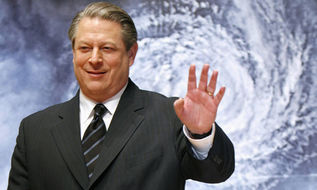

CLANGER: Bellamy says Al Gore has 'no proof' that millions will die due to global warming

"When I first stuck my head above the parapet to say I didn’t believe what we were being told about global warming I had no idea what the consequences would be.

I am a scientist and I have to ­follow the directions of science but when I see that the truth is being covered up I have to voice my ­opinions.

According to official data, in every year since 1998 world temperatures have been getting colder, and in 2002 Arctic ice actually increased. Why, then, do we not hear about that?

The sad fact is that since I said I didn’t believe human beings caused global warming I’ve not been allowed to make a TV programme.

My absence has been noticed, because wherever I go I meet people who say: “I grew up with you on the television, where are you now?”

It was in 1996 that I criticised wind farms while appearing on Blue Peter and I also had an article published in which I described global warming as poppycock.

SEARCH for:


The truth is, I didn’t think wind farms were an effective means of alternative energy so I said so. Back then, at the BBC you had to toe the line and I wasn’t doing that.

At that point I was still making loads of television programmes and I was enjoying it greatly. Then I suddenly found I was sending in ideas for TV shows and they weren’t getting taken up. I’ve asked around about why I’ve been ignored but I found that people didn’t get back to me.

CAMPAIGNER: Bellamy says we must stop destroying tropical rainforests
At the beginning of this year there was a BBC show with four experts saying: “This is going to be the end of all the ice in the Arctic,” and hypothesising that it was going to be the hottest summer ever. Was it hell! It was very cold and very wet and now we’ve seen evidence that the glaciers in Alaska have started growing rapidly – and they’ve not grown for a long time.

I’ve seen evidence, which I believe, that says there has not been a rise in global temperature since 1998, despite the increase in carbon dioxide being pumped into the atmosphere. This makes me think the global warmers are telling lies – carbon dioxide is not the driver.

The idiot fringe have accused me of being like a Holocaust denier, which is ludicrous. Climate change is all about cycles, it’s a natural thing and has always happened. When the Romans lived in Britain they were growing very good red grapes and making wine on the borders of Scotland. It was evidently a lot warmer.

If you were sitting next to me 10,000 years ago we’d be under ice. So thank God for global warming for ending that ice age; we wouldn’t be here otherwise.

People such as former American Vice-President Al Gore say that millions of us will die because of global warming – which I think is a pretty stupid thing to say if you’ve got no proof.

And my opinion is that there is absolutely no proof that carbon dioxide is anything to do with any impending catastrophe. The ­science has, quite simply, gone awry. In fact, it’s not even science any more, it’s anti-science.

There’s no proof, it’s just projections and if you look at the models people such as Gore use, you can see they cherry pick the ones that support their beliefs.

To date, the way the so-called Greens and the BBC, the Royal Society and even our political parties have handled this smacks of McCarthyism at its worst.

Global warming is part of a natural cycle and there’s nothing we can actually do to stop these cycles. The world is now facing spending a vast amount of money in tax to try to solve a problem that doesn’t actually exist.

And how were we convinced that this problem exists, even though all the evidence from measurements goes against the fact? God knows. Yes, the lakes in Africa are drying up. But that’s not global warming. They’re drying up for the very ­simple reason that most of them have dams around them.

So the water that used to be used by local people is now used in the production of cut flowers and veget­ables for the supermarkets of Europe.

One of Al Gore’s biggest clangers was saying that the Aral Sea in Uzbekistan was drying up because of global warming. Well, everyone knows, because it was all over the news 20 years ago, that the Russians were growing cotton there at the time and that for every ton of cotton you produce you use a vast amount of water.

The thing that annoys me most is that there are genuine environmental problems that desperately require attention. I’m still an environmentalist, I’m still a Green and I’m still campaigning to stop the destruction of the biodiversity of the world. But money will be wasted on trying to solve this global warming “problem” that I would much rather was used for looking after the people of the world.

Being ignored by the likes of the BBC does not really bother me, not when there are much bigger problems at stake.
I might not be on TV any more but I still go around the world campaigning about these important issues. For example, we must stop the dest­ruc­tion of trop­ical rainforests, something I’ve been saying for 35 years.

Mother nature will balance things out but not if we interfere by destroying rainforests and overfishing the seas.
That is where the real environmental catastrophe could occur.

Wednesday, October 22, 2008

More 'Change' coming with this election

As if you probably didn't already realize this, but we're getting ready to be taxed to death in the name of 'Saving The Planet'. (Reminder: while we 'developed' populations fret about how much money we can raise to save the fate of the polar bear and other furry, feathery, cuddly things, most in the legions of workers expanding the Chinese and Indian "carbon load" at the rate of 2.5 coal-fired electricity generating plants per week - not to mention all the other 'unwashed' peoples of the world - look at polar bears and all those other 'victims' like they might be good to eat.

We're royally screwed. The powers-that-be of our enemies must be laughing their asses off. The United States is going to implode on its guilt-induced altruism all by itself without the need for any of them to fire a shot. They'll just simply buy up all the assets at the bottom of the market and coopt the U.S. economy for their own purposes.

Think it's better with McCain? Only slightly. He basically agrees with the climate chicken littles.

Here's a glimpse of what's on the horizon next year from today's Wall Street Journal:

Obama's Carbon Ultimatum

The coming offer you won't be able to refuse.

Liberals pretend that only President Bush is preventing the U.S. from adopting some global warming "solution." But occasionally their mask slips. As Barack Obama's energy adviser has now made clear, the would-be President intends to blackmail -- or rather, greenmail -- Congress into falling in line with his climate agenda.

[Review & Outlook] AP

Jason Grumet is currently executive director of an outfit called the National Commission on Energy Policy and one of Mr. Obama's key policy aides. In an interview last week with Bloomberg, Mr. Grumet said that come January the Environmental Protection Agency "would initiate those rulemakings" that classify carbon as a dangerous pollutant under current clean air laws. That move would impose new regulation and taxes across the entire economy, something that is usually the purview of Congress. Mr. Grumet warned that "in the absence of Congressional action" 18 months after Mr. Obama's inauguration, the EPA would move ahead with its own unilateral carbon crackdown anyway.

Well, well. For years, Democrats -- including Senator Obama -- have been howling about the "politicization" of the EPA, which has nominally been part of the Bush Administration. The complaint has been that the White House blocked EPA bureaucrats from making the so-called "endangerment finding" on carbon. Now it turns out that a President Obama would himself wield such a finding as a political bludgeon. He plans to issue an ultimatum to Congress: Either impose new taxes and limits on carbon that he finds amenable, or the EPA carbon police will be let loose to ravage the countryside.

The EPA hasn't made a secret of how it would like to centrally plan the U.S. economy under the 1970 Clean Air Act. In a blueprint released in July, the agency didn't exactly say it'd collectivize the farms -- but pretty close, down to the "grass clippings." The EPA would monitor and regulate the carbon emissions of "lawn and garden equipment" as well as everything with an engine, like cars, planes and boats. Eco-bureaucrats envision thousands of other emissions limits on all types of energy. Coal-fired power and other fossil fuels would be ruled out of existence, while all other prices would rise as the huge economic costs of the new regime were passed down the energy chain to consumers.

These costs would far exceed the burden of a straight carbon tax or cap-and-trade system enacted by Congress, because the Clean Air Act was never written to apply to carbon and other greenhouse gases. It's like trying to do brain surgery with a butter knife. Mr. Obama wants to move ahead anyway because he knows that the costs of any carbon program will be high. He knows, too, that Congress -- even with strongly Democratic majorities -- might still balk at supporting tax increases on their constituents, even if it is done in the name of global warming.

Climate-change politics don't break cleanly along partisan lines. The burden of a carbon clampdown will fall disproportionately on some states over others, especially the 25 interior states that get more than 50% of their electricity from coal. Rustbelt manufacturing states like Ohio, Michigan and Pennsylvania will get hit hard too. Once President Bush leaves office, the coastal Democrats pushing hardest for a climate change program might find their colleagues splitting off, especially after they vote for a huge tax increase on incomes.

Thus Messrs. Obama and Grumet want to invoke a political deus ex machina driven by a faulty interpretation of the Clean Air Act to force Congress's hand. Mr. Obama and Democrats can then tell Americans that Congress must act to tax and regulate carbon to save the country from even worse bureaucratic consequences. It's Mr. Obama's version of Jack Benny's old "your money or your life" routine, but without the punch line.

The strategy is most notable for what it says about the climate-change lobby and its new standard bearer. Supposedly global warming is the transcendent challenge of the age, but Mr. Obama evidently doesn't believe he'll be able to convince his own party to do something about it without a bureaucratic ultimatum. Mr. Grumet justified it this way: "The U.S. has to move quickly domestically . . . We cannot have a meaningful impact in the international discussion until we develop a meaningful domestic consensus."

Normally a democracy reaches consensus through political debate and persuasion, but apparently for Mr. Obama that option is merely a nuisance. It's another example of "change" you'll be given no choice but to believe in.

Friday, September 5, 2008

AGW Challenge from the Heartland of Eco-Hysteria!

Irish Environment Minister Sammy Wilson Calls Green Movement "hysterical psuedo-religion"


(http://news.bbc.co.uk/2/hi/uk_news/northern_ireland/7599810.stm)

Wilson row over green 'alarmists'

Sammy Wilson's view on climate change has angered environmentalists


The (Norther Ireland) Environment Minister Sammy Wilson has angered green campaigners by describing their view on climate change as a "hysterical psuedo-religion".

In an article in the News Letter, Mr Wilson said he believed it occurred naturally and was not man-made.

"Resources should be used to adapt to the consequences of climate change, rather than King Canute-style vainly trying to stop it," said the minister.

Peter Doran of the Green Party said it was a "deeply irresponsible message."

Mr Wilson said he refused to "blindly accept" the need to make significant changes to the economy to stop climate change.

"The tactic used by the "green gang" is to label anyone who dares disagree with their view of climate change as some kind of nutcase who denies scientific fact," he said.


The minister said he accepted climate change can occur, but does not believe the cause has been identified.

"Reasoned debate must replace the scaremongering of the green climate alarmists."

John Woods of Friends of the Earth said Mr Wilson was "like a cigarette salesman denying that smoking causes cancer".

"Ironically, if we listen to him Northern Ireland will suffer economically as we are left behind by smarter regions who are embracing the low carbon economy of the future."

It is the latest clash between Mr Wilson and green groups since his appointment as environment minister in June.


Monday, August 4, 2008

Just to clarify...what's my position?

I try to avoid being overty boorish with politically-charged messages. I'm not an activist for too many causes. (Jokes are SO much more useful than editorials.) But I *do* think the climate change thing is hugely important, because I think it will be a key theme guiding discourse as we and our children grapple with volatility of all kinds in our world in the next couple of decades. I just wanted to clarify for you where I stand, because it's obvious by accusations I often have to deflect that some people have jumped to conclusions about my entire social ideology that are just not the least bit accurate.

The principles for which one chooses to fight for often get lost and forgotten in the 'fog of war'. Especially when you carry a battleflag of a cause in a war as broad and incendiary as the climate change war. It's inevitable as you lob and endure volleys over a great expanse of time that your original message and intent get distorted in the view of observers on all sides. Opponents and supporters alike propagandize your message for their own purposes.

At various times I am accused of advocating or attacking things I do not and would not. In fact I am in agreement with many of my presumptive attackers on key points. Once that gets out in the open, if we don't kill each other first, we end up grabbing a beer together.
To clarify, the central theme of my position on the climate is NOT any of the following:

Things Jesse does not think:
  1. Greenies are pansies and have nothing to of value to offer.
  2. Conservation is stupid.
  3. Guns are good(?).
  4. We should abandon the search for alternative fuels.
  5. The world is not experiencing climate change.
  6. All those scientists who believe man-made climate change is occurring now are dumbasses.
  7. The science is settled with the opinions of all those scientists who believe climate change is natural prevailing.

To clarify further,

Things Jesse thinks:
  1. The science of climate change is unsettled, both ways. Nothing has been 'proven'. There simply is not enough hard data to prove anything. Drawing hard, war-fighting conclusions from 100 years of increasingly better hard data lumped with 5 billion years of poor-quality inferential data is a scientifically and statistically indefensible procedure. As is dismissing the possibility we really are heating things up with our cars. Either one or both may be right. (But, which it is does not matter.)
  2. Resource conservation is as desirable as exploration and development of ALL energy sources.
  3. Free markets are remarkably effective at imposing conservation and innovation that require no apparatus.
  4. The earth has always experienced climate change. And always will. Naturally. Climate change is a constant reality. Note that does not mean we can't be affecting it, too. (But how did Greenland get its name?)
  5. Ok. Happiness is a warm gun. The distinction is really important.
  6. We cannot do anything but waste money trying to 'fix' climate change, regardless of the actual cause. The only productive thing to do is figure out how to live and prosper with it. Mother Nature and eco-political competition will simply trounce all of man's capabilities.
  7. There are a great many opportunists that want you to contribute money to them to "fix it". From politicians to billionaires. Climate change is a huge business because it has been brought to the forefront of the collective consciousness. Just like Y2K a few years back.
  8. #7 is bad for most of us because it will lighten your wallet while making someone else's fatter. All while not fixing anything except their bank account. Once the fix machine gains inertia it will be nearly impossible to stop. When the climate is warming, the message will be, "We need to do MORE! Give us more money.". When the climate is cooling, the message will be, "Hurray. Look at how great we are! We fixed it! We can do even more! Give us more money!".
  9. This is all bad for most of us in the free world because it will lighten your wallet and erode your freedom while making someone else's wallet fatter and power more concetrated. All while not fixing anything except their bank account and power base. In short, it's a ripoff and an altruism revolution full of landmines. On a global scale.

Someone needs put a spotlight on this conclusion so that people can make more informed decisions.

I am.

Sunday, June 22, 2008

There is Hope for Mankind!

Just when I was starting to lose faith in my fellow man's bullshit detectors, we have this. A poll conducted by Ipsos MORI in the UK finds that a majority of Brits believe climate change hysteria to be unjustified and a that the problem is being exagerrated by the science community.

HOORAY!

Yet further evidence that this is a fairy tale being driven down our throats from the top, down.

Friday, June 6, 2008

That hand you feel in your back pocket

(How much of your money do the hucksters of the the new millenium want? Pretty much all of it. The amount they've come up with is three times the GDP of the United States. Mere "chump change" as they say. Unless you're the chump. All to pursue an unattainable goal.

Better find a job making windmills.)

$45 trillion needed to combat warming

By JOSEPH COLEMAN, Associated Press Writer Fri Jun 6, 7:06 AM ET

TOKYO - The world needs to invest $45 trillion in energy in coming decades, build some 1,400 nuclear power plants and vastly expand wind power in order to halve greenhouse gas emissions by 2050, according to an energy study released Friday.

The report by the Paris-based International Energy Agency envisions a "energy revolution" that would greatly reduce the world's dependence on fossil fuels while maintaining steady economic growth.

"Meeting this target of 50 percent cut in emissions represents a formidable challenge, and we would require immediate policy action and technological transition on an unprecedented scale," IEA Executive Director Nobuo Tanaka said.

A U.N.-network of scientists concluded last year that emissions have to be cut by at least half by 2050 to avoid an increase in world temperatures of between 3.6 and 4.2 degrees above pre-18th century levels.

Scientists say temperature increases beyond that could trigger devastating effects, such as widespread loss of species, famines and droughts, and swamping of heavily populated coastal areas by rising oceans.

Environment ministers from the Group of Eight industrialized countries and Russia backed the 50 percent target in a meeting in Japan last month and called for it to be officially endorsed at the G-8 summit in July.

The IEA report mapped out two main scenarios: one in which emissions are reduced to 2005 levels by 2050, and a second that would bring them to half of 2005 levels by mid-century.
The scenario for deeper cuts would require massive investment in energy technology development and deployment, a wide-ranging campaign to dramatically increase energy efficiency, and a wholesale shift to renewable sources of energy.

Assuming an average 3.3 percent global economic growth over the 2010-2050 period, governments and the private sector would have to make additional investments of $45 trillion in energy, or 1.1 percent of the world's gross domestic product, the report said.

That would be an investment more than three times the current size of the entire U.S. economy.
The second scenario also calls for an accelerated ramping up of development of so-called "carbon capture and storage" technology allowing coal-powered power plants to catch emissions and inject them underground.

The study said that an average of 35 coal-powered plants and 20 gas-powered power plants would have to be fitted with carbon capture and storage equipment each year between 2010 and 2050.

In addition, the world would have to construct 32 new nuclear power plants each year, and wind-power turbines would have to be increased by 17,000 units annually. Nations would have to achieve an eight-fold reduction in carbon intensity — the amount of carbon needed to produce a unit of energy — in the transport sector.

Such action would drastically reduce oil demand to 27 percent of 2005 demand. Failure to act would lead to a doubling of energy demand and a 130 percent increase in carbon dioxide emissions by 2050, IEA officials said.

"This development is clearly not sustainable," said Dolf Gielen, an IEA energy analyst and leader for the project.

Gielen said most of the $45 trillion forecast investment — about $27 trillion — would be borne by developing countries, which will be responsible for two-thirds of greenhouse gas emissions by 2050.

Most of the money would be in the commercialization of energy technologies developed by governments and the private sector.

"If industry is convinced there will be policy for serious, deep CO2 emission cuts, then these investments will be made by the private sector," Gielen said.

Friday, May 23, 2008

Wonder what the carbon load is on Jupiter?

Seems we aren't the only rock in the universe experiencing climate change. Jupiter - OK. It's not technically a rock - is cooking a little differently these days. Or so some scientists say. We can trust them. Right?

http://antwrp.gsfc.nasa.gov/apod/ap080523.html

Monday, April 28, 2008

Impeccable Credentials and Broad Experience in Climatology? Pffftt.

If you dare challenge the so-called consensus. In a most blatant example of how eco-nazi's are dead set determined to silence AGW critics, Colorado State University has threatened its Dr. William Gray, the godfather of hurricane forecasting as we know it, with loss of university support.

http://www.chron.com/disp/story.mpl/front/5736103.html

Hasn't this guy learned that rational arguments have no place in the 21st century?

email I received this morning

> April 26, 2008, 9:00 a.m.
>
> Chickenfeedhawks
> Global warm-mongering.
>
> By Mark Steyn
>
>
>
> Last week, Time magazine featured on its cover the iconic photograph
> of the U.S. Marine Corps raising the flag on Iwo Jima. But with one
> difference: The flag has been replaced by a tree. The managing editor
> of Time, Rick Stengel, was very pleased with the lads in graphics for
> cooking up this cute image and was all over the TV sofas talking up
> this ingenious visual shorthand for what he regards as the greatest
> challenge facing mankind: "How To Win The War On Global Warming."
>
> Where to begin? For the last ten years, we have, in fact, been not
> warming but slightly cooling, which is why the eco-warriors have
> adopted the all-purpose bogeyman of "climate change." But let’s take
> it that the editors of Time are referring not to the century we live
> in but the previous one, when there was a measurable rise of
> temperature of approximately one degree. That’s the "war": one
> degree.
>
> If the tree-raising is Iwo Jima, a one-degree increase isn’t exactly
> Pearl Harbor. But General Stengel wants us to engage in preemptive
> war. The editors of Time would be the first to deplore such
> saber-rattling applied to, say, Iran’s nuclear program, but it has
> become the habit of progressive opinion to appropriate the language
> of war for everything but actual war.
>
> So let’s cut to the tree. In my corner of New Hampshire, we have more
> trees than we did a hundred or two hundred years ago. My town is over
> 90 percent forested. Any more trees and I’d have to hack my way
> through the undergrowth to get to my copy of Time magazine on the
> coffee table. Likewise Vermont, where not so long ago in St Albans I
> found myself stuck behind a Hillary supporter driving a Granolamobile
> bearing the bumper sticker "TO SAVE A TREE REMOVE A BUSH." Very
> funny. And even funnier when you consider that on that stretch of
> Route Seven there’s nothing to see north, south, east, or west but
> maple, hemlock, birch, pine, you name it. It’s on every measure other
> than tree cover that Vermont’s kaput.
>
> So where exactly do Time magazine’s generals want to plant their
> tree? Presumably, as in Iwo Jima, on foreign soil. It’s all these
> third-world types monkeying around with their rain forests who
> decline to share the sophisticated Euro-American reverence for the
> tree. In the Time iconography, the tree is Old Glory and it’s a flag
> of eco-colonialism.
>
> And which obscure island has it been planted on? In Haiti, the Prime
> Minister Jacques Edouard Alexis was removed from office on April 12.
> Insofar as history will recall him at all, he may have the
> distinction of being the first head of government to fall victim to
> "global warming" — or, at any rate, the "war on global warming" that
> Time magazine is gung-ho for. At least five people have been killed
> in food riots in Port-au-Prince. Prices have risen 40 percent since
> last summer and, as Deroy Murdock reported, some citizens are now
> subsisting on biscuits made from salt, vegetable oil and (mmmm) dirt.
> Dirt cookies: Nutritious, tasty, and affordable? Well, one out of
> three ain’t bad.
>
> Unlike "global warming," food rioting is a planet-wide phenomenon,
> from Indonesia to Pakistan to Ivory Coast to the tortilla rampages in
> Mexico and even pasta protests in Italy.
>
> So what happened?
>
> Well, Western governments listened to the eco-warriors, and
> introduced some of the "wartime measures" they’ve been urging. The EU
> decreed that 5.75 percent of petrol and diesel must come from
> "biofuels" by 2010, rising to 10 percent by 2020. The U.S. added to
> its 51 cents-per-gallon ethanol subsidy by mandating a five-fold
> increase in "biofuels" production by 2022.
>
> The result is that big government accomplished at a stroke what the
> free market could never have done: They turned the food supply into a
> subsidiary of the energy industry. When you divert 28 percent of U.S.
> grain into fuel production, and when you artificially make its value
> as fuel higher than its value as food, why be surprised that you’ve
> suddenly got less to eat? Or, to be more precise, it’s not "you"
> who’s got less to eat but those starving peasants in distant lands
> you claim to care so much about.
>
> Heigh-ho. In the greater scheme of things, a few dead natives keeled
> over with distended bellies is a small price to pay for saving the
> planet, right? Except that turning food into fuel does nothing for
> the planet in the first place. That tree the U.S. Marines are raising
> on Iwo Jima was most likely cut down to make way for an
> ethanol-producing corn field: Researchers at Princeton calculate that
> to date the "carbon debt" created by the biofuels arboricide will
> take 167 years to reverse.
>
> The biofuels debacle is global warm-mongering in a nutshell: The
> first victims of poseur environmentalism will always be developing
> countries. In order for you to put biofuel in your Prius and feel
> good about yourself for no reason, real actual people in faraway
> places have to starve to death. On April 15, the Independent, the
> impeccably progressive British newspaper, editorialized: "The
> production of biofuel is devastating huge swathes of the world’s
> environment. So why on earth is the Government forcing us to use more
> of it?"
>
> You want the short answer? Because the government made the mistake of
> listening to fellows like you. Here’s the self-same Independent in
> November 2005:
>
>
> At last, some refreshing signs of intelligent thinking on
> climate change are coming out of Whitehall. The Environment
> minister, Elliot Morley, reveals today in an interview with
> this newspaper that the Government is drawing up plans to
> impose a ‘biofuel obligation’ on oil companies... This has the
> potential to be the biggest green innovation in the British
> petrol market since the introduction of unleaded petrol…
>
>
> Etc. It’s not the environmental movement’s chickenfeedhawks who’ll
> have to reap what they demand must be sown, but we should be in no
> doubt about where to place the blame — on the bullying activists and
> their media cheerleaders and weathervane politicians who insist that
> the "science" is "settled" and that those who query whether there’s
> any crisis are (in the designation of the strikingly non-emaciated Al
> Gore) "denialists." All three presidential candidates have drunk the
> environmental kool-ethanol and are committed to Big Government
> solutions. But, as the Independent’s whiplash-inducing U-turn
> confirms, the eco-scolds are under no such obligation to consistency.
> Finger-in-the-wind politicians shouldn’t be surprised to find that
> gentle breeze is from the media wind turbine and it’s just sliced
> your finger off.
>
> Whether or not there’s very slight global cooling or very slight
> global warming, there’s no need for a "war" on either, no rationale
> for loosing a plague of eco-locusts on the food supply. So why be
> surprised that totalitarian solutions to mythical problems wind up
> causing real devastation? As for Time’s tree, by all means put it up:
> It helps block out the view of starving peasants on the far horizon.
>
>
>
>
>

Thursday, April 10, 2008

Climate experts predict temperature drop

Climate experts predict temperature drop

Even pro-AGW scientists agree with me

At least these pro-AGW scientists 'get' the futility of 'controlling' GW

Of course this POV has absolutely no chance of advancement, because nobody would need to collect carbon taxes to do nothing.

And it's always about the money.

Tuesday, April 8, 2008

When can we expect people to start seeing through the "Global Warming" brand?

Yet another rational perspective about global warming. I was particularly drawn to his use of "McCarthy-ism" to describe the political-scientific community's zeal. That's the "spot-on" description I've been trying to pin down for the AGW "movement".

USA Today: Expert: "We're brainwashing our children" about global warming

If you don't think the AGW "movement" is a real threat to your core values, your freedoms and your pocketbook, just consider these two comments posted by readers of that article:

TeddyMacMD wrote: since when is conserving fuel/energy or reducing harmful waste a BAD thing? duh

AND

"A little lesson in conserving our earth to keep it livable never hurt anyone. Accepting pollution is like deciding you can eat, sleep and drink in you own ceptic tank."

Wow! Nobody has ever come so close to making my case for me as this guy. There are untold numbers of people out there that agree that incorrectly linking conservation habits with a "fight" against an enemy they cannot define, quantity, or aim at, is perfectly rational. They can't see any harm in more taxes and limits and regulations, even when the justification may be totally false and baseless, not to mention that all those new controls can't, ultimately, "fix the problem", no matter it's cause. Why? Cause that's what we always do when we think something is broken. Right? Right?

Brainwash is right, folks.

Tuesday, March 25, 2008

A Couple of Items Illustrating Disarray and Infighting in the AGW Movement

In this NY Times article:

Link to Global Warming in Frogs’ Disappearance Is Challenged

and

This story from the UK

I never heard the term "we don't know" so often from a group that supposedly has settled so much.

Sunday, March 23, 2008

And The Evidence Continues to Mount...Unrelentingly.

That the IPCC doesn't understand the problem they have created an empire to solve. From down under...

CATASTROPHIC predictions of global warming usually conjure with the notion of a tipping point, a point of no return.Last Monday - on ABC Radio National, of all places - there was a tipping point of a different kind in the debate on climate change. It was a remarkable interview involving the co-host of Counterpoint, Michael Duffy and Jennifer Marohasy, a biologist and senior fellow of Melbourne-based think tank the Institute of Public Affairs. Anyone in public life who takes a position on the greenhouse gas hypothesis will ignore it at their peril.

Duffy asked Marohasy: "Is the Earth stillwarming?"

She replied: "No, actually, there has been cooling, if you take 1998 as your point of reference. If you take 2002 as your point of reference, then temperatures have plateaued. This is certainly not what you'd expect if carbon dioxide is driving temperature because carbon dioxide levels have been increasing but temperatures have actually been coming down over the last 10 years."

Duffy: "Is this a matter of any controversy?"

Marohasy: "Actually, no. The head of the IPCC (Intergovernmental Panel on Climate Change) has actually acknowledged it. He talks about the apparent plateau in temperatures so far this century. So he recognises that in this century, over the past eight years, temperatures have plateaued ... This is not what you'd expect, as I said, because if carbon dioxide is driving temperature then you'd expect that, given carbon dioxide levels have been continuing to increase, temperatures should be going up ... So (it's) very unexpected, not something that's being discussed. It should be being discussed, though, because it's very significant."

The entire article ....

http://www.theaustralian.news.com.au/story/0,25197,23411799-7583,00.html

Wednesday, March 19, 2008

Duh! How can the earth be warming if the oceans are not?

And now comes the NASA JPL with its own study of ocean temperatures that revealed a surprising thing. Surprising, that is, if you are a chicken little AGW zealot. Their project uses an array of 3,000 buoys that not only measure surface temps, but at depths up to 3,000 feet down.

Seems that the oceans have not been getting warmer at all.... Surprised?

http://www.npr.org/templates/story/story.php?storyId=88520025

Saturday, March 8, 2008

Fear, fear, more fear and alarm. Baseless conclusions.

Pretty soon they'll be blaming climate change for the Kennedy assassination...

The conflict in Darfur, migration from flood-prone Bangladesh and hopes for stability in the Middle East, according to a new EU report.

From Africa to Asia, and from pole to pole, climate change has become "a threat multiplier which exacerbates existing trends, tensions and instability," warns the seven-page report on "Climate change and international security", to be presented to a European summit in Brussels on March 13-14.

Among the listed threats are "reduction of arable land, widespread shortage of water, diminishing food and fish stocks, increased flooding and prolonged droughts."
These problems, according to the report drawn up by the offices of EU foreign policy chief Javier Solana and EU External Relations Commissioner Benita Ferrero-Waldner, "are already happening in many parts of the world".

The rest of the fiction.....

Another example of chicken little's sad, shrill exaggeration

This appears in the UK-based TimesOnline. Another example of "the-end-justifies-the-means" practice of hyperbole and distortion employed by Eco-nazis to spread their dogma of fear and alarm:

Series of blunders turned the plastic bag into global villain

Scientists and environmentalists have attacked a global campaign to ban plastic bags which they say is based on flawed science and exaggerated claims.

The widely stated accusation that the bags kill 100,000 animals and a million seabirds every year are false, experts have told The Times. They pose only a minimal threat to most marine species, including seals, whales, dolphins and seabirds...

The whole article...

Friday, February 29, 2008

Twelve-month long drop in world temperatures wipes out a century of warming

China has its coldest winter in 100 years. Baghdad sees its first snow in all recorded history. North America has the most snowcover in 50 years, with places like Wisconsin the highest since record-keeping began. Record levels of Antarctic sea ice, record cold in Minnesota, Texas, Florida, Mexico, Australia, Iran, Greece, South Africa, Greenland, Argentina, Chile — the list goes on and on.No more than anecdotal evidence, to be sure. But now, that evidence has been supplanted by hard scientific fact. All four major global temperature tracking outlets (Hadley, NASA’s GISS, UAH, RSS) have released updated data. All show that over the past year, global temperatures have dropped precipitously.The total amount of cooling ranges from 0.65C up to 0.75C — a value large enough to wipe out nearly all the warming recorded over the past 100 years. All in one year’s time. For all four sources, it’s the single fastest temperature change ever recorded, either up or down.

Wednesday, February 27, 2008

Law of Unintended Consequences

I'm all for alternative energy research. Get us off the oil tit. But, like anything, I think you must meter carefully how quickly you rush to embrace this or that and balance the need to innovate against the need to understand and mitigate the attendant risks.

Here's what we in Texas learned about the brave new world of alternative energy yesterday:

Loss of wind causes Texas power grid emergency

Saturday, February 23, 2008

This guy "gets it"

GM exec stands by calling global warming a "crock"

Not because he calls it a crock, but because he gets the bigger picture that his critics miss.

Thursday, February 14, 2008

How your money will be spent if you start handing over "Carbon Taxes"

Analysis of Londoners' experience with carbon tax revenue.

The Domino Effect of Misguided Irrationality Masquerading as Political Action

This column by George Will in last week's Newsweek about the domino effect of environmental altruism run amok provides an interesting perspective of how real-world political wranglings by eco-zealots here in the US actually result in the global effect of an increase in both the carbon load and the trade deficit.

There's gold in them thar green hills

What's a politician like NYC mayor Michael Bloomberg's motivation for shoving a "carbon tax" down your throat? Easy. He's seen what it's done for the city of London. Not for the people of the city. No. But for the governing apparatus. It's called empire building.

As of 27 Oct 2008, the city of London will levy £25 *per day* in carbon duties if you drive something like a pickup truck into the city. That and other so-called 'green' levies amount to an expansion of the London municipal coffers by close to a half-billion US$ a year. What do they do with that money? Well, pretty much anything they want. (
See this post for a breakdown)

London's example, of course, now creates an imperative, and marketing plan, for every civic manager in the world to pursue this fresh, fertile revenue stream; you're irresponsible to your charter - and mankind - if you don't. To do with pretty much as you please. All generated from uninformed hysteria over an unproven theory rampantly marketed by every half-educated half-wit on the planet to the delight of the true manipulators.

The IPCC's Anthropogenic Global Warming is the greatest Multi-Level Marketing scheme ever devised.

Socialism has arrived and it is dressed in green.